topic 2.9: photosynthesis
In the Photosynthesis unit we will learn how light energy is converted into chemical energy. Every living creature needs food or energy to survive. Some depend on others for food and energy, whiles others can produce their own food. Plants make their own food, glucose, in a process called photosynthesis. We say that plants can photosynthesise.
Photosynthesis and respiration go hand in hand. The result of photosynthesis is glucose, which is stored as chemical energy in the plant cells.
This stored chemical energy comes from the conversion of inorganic carbon (carbon dioxide) into organic carbon. Respiration releases the stored chemical energy.
The unit is planned to take 3 school days
Photosynthesis and respiration go hand in hand. The result of photosynthesis is glucose, which is stored as chemical energy in the plant cells.
This stored chemical energy comes from the conversion of inorganic carbon (carbon dioxide) into organic carbon. Respiration releases the stored chemical energy.
The unit is planned to take 3 school days
Essential idea:
- Photosynthesis uses the energy in sunlight to produce the chemical energy needed for life.
Nature of science:
- Experimental design—controlling relevant variables in photosynthesis experiments is essential. (3.1)
- Define independent variable, controlled variable and responding variable.
- Define independent variable, controlled variable and responding variable.
Understanding:
2.9.U1 Photosynthesis is the production of carbon compounds in cells using light energy.
- Define photosynthesis.
- State the chemical equation for photosynthesis.
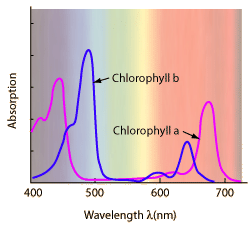
Photosynthesis is the fundamental process by which plants manufacture food molecules (carbohydrates) from raw materials CO2 and H2O) using energy from light.
This process requires a photosynthetic pigment (chlorophyll) and can only occur in certain organisms (plants, certain bacteria)
This process requires a photosynthetic pigment (chlorophyll) and can only occur in certain organisms (plants, certain bacteria)
2.9.U2 Visible light has a range of wavelengths with violet the shortest wavelength and red the longest.
- Define visible light.
- State the relationship between wavelength and energy.
- State the range of wavelengths that fall within the visible spectrum.
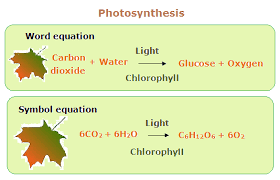
The electromagnetic spectrum is the range of all possible frequencies of electromagnetic radiation. Sunlight/ light made up of wavelengths of electromagnetic radiation that our eyes can detect = visible to us and other wavelengths are invisible visible light = wavelengths longer than ultraviolet/ shorter than infrared / range of wavelengths of visible light is 400 to 700 nanometer.
The colours of the visible spectrum are (from longest to shortest wavelength):
Red Orange Yellow Green Blue Indigo Violet (Mnemonic: Roy G. Biv)
The colours of the visible spectrum are (from longest to shortest wavelength):
Red Orange Yellow Green Blue Indigo Violet (Mnemonic: Roy G. Biv)
2.9.U3 Chlorophyll absorbs red and blue light most effectively and reflects green light more than other colours
- .Define pigment.
- State the primary and accessory pigments found in chloroplasts.
- Explain why plants are green.
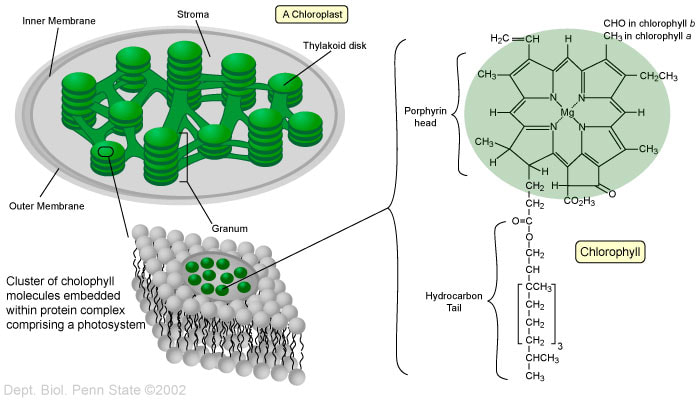
Chlorophyll is a green pigment found in photosynthetic organisms that is responsible for light absorption. When chlorophyll absorbs light, it releases electrons which are used to synthesise ATP (chemical energy). Chemical substance called pigment involved in first step pf photosynthesis.
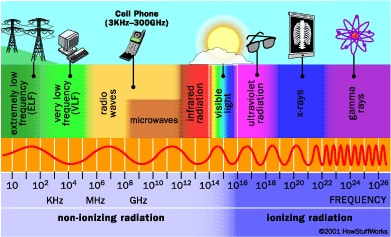
Chlorophyll absorbs light most strongly in the blue portion of the visible spectrum, followed by the red portion
Chlorophyll reflects light most strongly in the green portion of the visible spectrum (hence the green colour of leaves)
Chlorophyll absorbs light most strongly in the blue portion of the visible spectrum, followed by the red portion
Chlorophyll reflects light most strongly in the green portion of the visible spectrum (hence the green colour of leaves)
2.9.U4 Oxygen is produced in photosynthesis from the photolysis of water.
- Define photolysis.
- State the equation for photolysis.
- State that the oxygen produced in photolysis is a waste product of photosynthesis
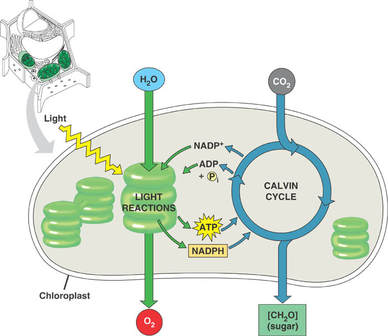
The splitting of molecules of water to release electrons needed in other stages (photolysis)
Step 1: Light Dependent Reactions
Step 2: Light Independent Reactions
Step 1: Light Dependent Reactions
- Light is absorbed by chlorophyll, which results in the production of ATP (chemical energy)
- Light is also absorbed by water, which is split (photolysis) to produce oxygen and hydrogen
- The hydrogen and ATP are used in the light independent reactions, the oxygen is released from stomata as a waste product
Step 2: Light Independent Reactions
- ATP and hydrogen (carried by NADPH) are transferred to the site of the light independent reactions
- The hydrogen is combined with carbon dioxide to form complex organic compounds (e.g. carbohydrates, amino acids, etc.)
- The ATP provides the required energy to power these anabolic reactions and fix the carbon molecules together
2.9.U5 Energy is needed to produce carbohydrates and other carbon compounds from carbon dioxide.
- State the energy conversion that occurs during photosynthesis.
ATP and hydrogen derived from photolysis of water are used to fix carbon dioxide to make organic molecules. Plants convert carbon dioxide into glucose through the Calvin cycle in photosynthesis. This process requires energy from light being put in and so is described as being endothermic.
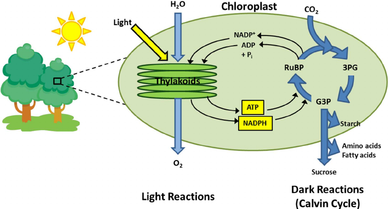
image from ResearchGate
2.9.U6 Temperature, light intensity and carbon dioxide concentration are possible limiting factors on the rate of photosynthesis.
- Define “limiting factor.”
- Explain how the following factors limit the rate of photosynthesis:
- Temperature
- Light intensity
- CO2 concentration
The law of limiting factors states that when a chemical process depends on more than one essential condition being favourable, the rate of reaction will be limited by the factor that is nearest its minimum value
Photosynthesis is dependent on a number of favourable conditions, including:
Photosynthesis is dependent on a number of favourable conditions, including:
- Temperature
- Light intensity
- Carbon dioxide concentration
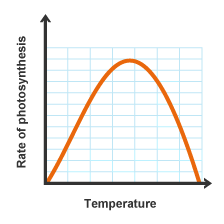
If it gets too cold, the rate of photosynthesis will decrease as enzyme activity is low. Plants cannot photosynthesise if it gets too hot either as the enzymes controlling it are denatured.
|
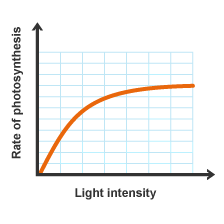
Without enough light, a plant cannot photosynthesise very quickly, even if there is plenty of water and carbon dioxide. Increasing the light intensity will boost the speed of photosynthesis and then the rate will become steady as something else is a limiting factor, eg temperature or carbon dioxide concentration
|
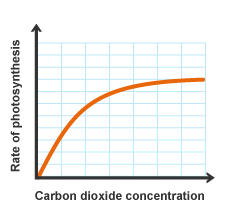
Sometimes photosynthesis is limited by the concentration of carbon dioxide in the air. Even if there is plenty of light, a plant cannot photosynthesise if there is insufficient carbon dioxide. Increasing the concentration of carbon dioxide will boost the speed of photosynthesis and then the rate will become steady as something else is a limiting factor, eg temperature or light intensity.
|
Application:
2.9.A1 Changes to the Earth’s atmosphere, oceans and rock deposition due to photosynthesis.
- State that (some) prokaryotes, algae and plants carry out photosynthesis.
- Define and state evidence for the “Great Oxidation Event.”
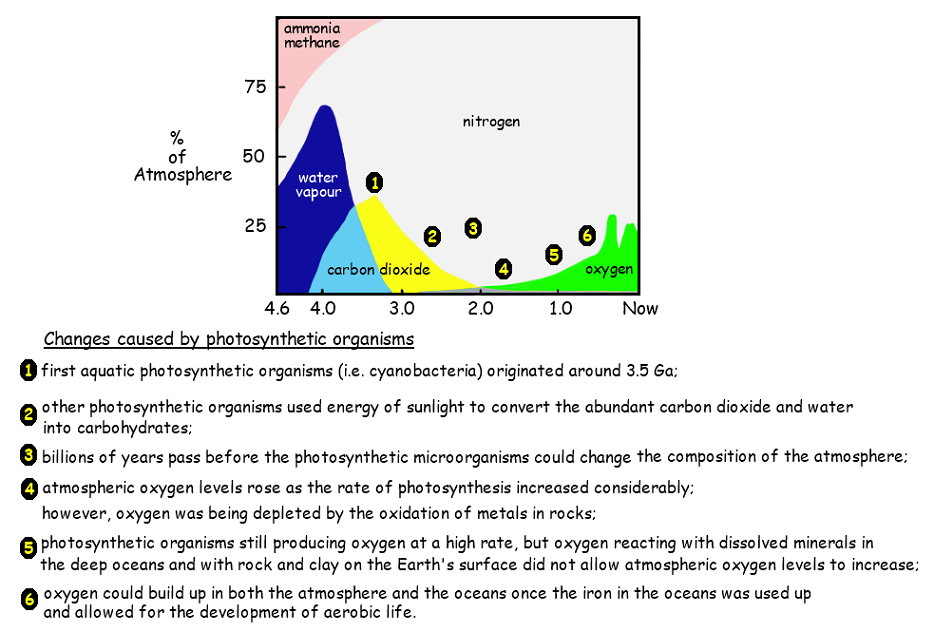
Only one significant source of oxygen gas exists in the known universe – biological photosynthesis. Before the evolution of photosynthetic organisms, any free oxygen produced was chemically captured and stored. Approximately 2.3 billion years ago, photosynthetic organisms began to saturate the environment with oxygen. This led to changes in the Earth’s atmosphere, oceans, rock deposition and biological life
Skill
2.9.S1 Drawing an absorption spectrum for chlorophyll and an action spectrum for photosynthesis.
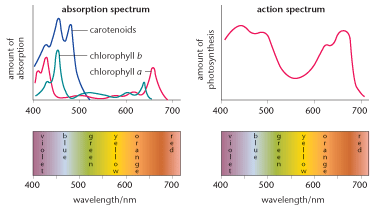
- Distinguish between an action spectrum and an absorption spectrum.
- Describe the shape of the curve for an absorption spectrum.
- Describe the shape of the curve for an action spectrum.
Know that visible light has wavelengths between 400 and 700 nanometres, but you are not expected to recall the wavelengths of specific colors of light.
Pigments absorb light as a source of energy for photosynthesis
Pigments absorb light as a source of energy for photosynthesis
- The absorption spectrum indicates the wavelengths of light absorbed by each pigment (e.g. chlorophyll)
- The action spectrum indicates the overall rate of photosynthesis at each wavelength of light
2.9.S2 Design of experiments to investigate the effect of limiting factors on photosynthesis.
- List mechanism for measuring the rate of photosynthesis
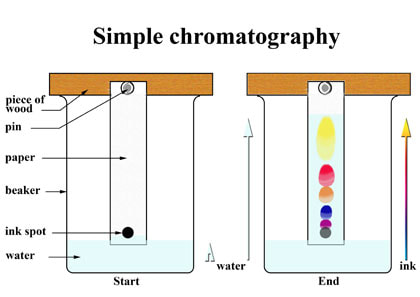
2.9.S3 Separation of photosynthetic pigments by chromatography.
(Practical 4)
(Practical 4)
- Outline the process of separating pigments using chromatography
- Calculate the Rf value for pigments using pigment chromatography.
Paper chromatography can be used to separate photosynthetic pigments but thin layer chromatography gives better results.
Photosynthetic organisms do not rely on a single pigment to absorb light, but instead benefit from the combined action of many. These pigments include chlorophylls, xanthophyll and carotenes. Chromatography is an experimental technique by which mixtures can be separated
Two of the most common techniques for separating photosynthetic pigments are:
Photosynthetic organisms do not rely on a single pigment to absorb light, but instead benefit from the combined action of many. These pigments include chlorophylls, xanthophyll and carotenes. Chromatography is an experimental technique by which mixtures can be separated
Two of the most common techniques for separating photosynthetic pigments are:
- Paper chromatography – uses paper (cellulose) as the stationary bed
- Thin layer chromatography – uses a thin layer of adsorbent (e.g. silica gel) which runs faster and has better separation
Key Terms:
|
photosynthesis
absorption light intensity visible light ATP action spectrum |
chemical energy
photolysis temperature visible spectrum ADP absorption spectrum |
wavelengths
biomass carbon dioxide chloroplasts limiting factors chromatography |
chlorophyll
light-dependent carbohydrates rock deposition Rf value |
pigment
light-independent potometer glucose Great Oxidation Event |
Class Materials:
Photosynthesis simulation
Leaf Chromotography
Leaf Impressions
Leaf drawings
Leaves Internal Structure
Why are plants not always green
Topic 2.9 Review
Photosynthesis simulation
Leaf Chromotography
Leaf Impressions
Leaf drawings
Leaves Internal Structure
Why are plants not always green
Topic 2.9 Review
Powerpoint and notes on Topic 2.9 from Chris Payne
Correct use of terminology is a key skill in Biology. It is essential to use key terms correctly when communicating your understanding, particularly in assessments. Use the quizlet flashcards or other tools such as learn, scatter, space race, speller and test to help you master the vocabulary.
Useful Links:
Simple online demo from KScience
Virtual Lab: Wavelength and Photosynthesis from Glencoe Biology
Light intensity vs rate of photosynthesis, from Reading University
Click here then insert the expres code 4273P and click on Weblink 3.8
Animations from McGraw Hill
Illuminating Photosynthesis from NOVA
In the News:
Colder weather lets colors of autumn emerge from StarHearld.com
Photosynthesis-like process found in insects from Nature Magazine
Maths study of photosynthesis clears the path to developing new super-crops from Seed Daily
Video Clips:
Hank explains the extremely complex series of reactions whereby plants feed themselves on sunlight, carbon dioxide and water, and also create some by products we're pretty fond of as well.
Paul Andersen explains the process of photosynthesis by which plants and algae can convert carbon dioxide into useable sugar. He begins with a brief description of the chloroplast. He describes the major pigments in a plant (like chlorophyll a and b). He then describes both the light reaction and the Calvin cycle. He finishes with a discussion of photorespiration and strategies for avoiding this problem evolved in CAM and C4 plants.
Photosynthesis is an essential part of the exchange between humans and plants. Amanda Ooten walks us through the process of photosynthesis, also discussing the relationship between photosynthesis and carbohydrates, starch, and fiber -- and how the air we breathe is related to the food we ingest
A hearty bowl of cereal gives you the energy to start your day, but how exactly did that energy make its way into your bowl? It all begins with photosynthesis, the process that converts the air we breathe into energizing glucose. Cathy Symington details the highly efficient second phase of photosynthesis -- called the Calvin cycle -- which converts carbon dioxide into sugar with some clever mix-and-match math.
